
Rethinking How We Design Adult Learning: Cheese Sauce or Simple Sauté
August 12, 2026 in Industry Insights, Learning, Learning & Development
By Elizabeth Schmidt
Encouraging adults to complete training can sometimes feel like persuading kids to eat their vegetables. The solution is to stop designing adult learning as if we are serving something learners must be tricked into consuming.
Imagine two plates of vegetables in front of you. One is covered in a thick, bright yellow sauce that smells faintly of processed cheese and has the consistency of used motor oil. This is how adult learners are too often served web-based training: buried under unnecessary gimmicks, redundant interactions, and superfluous content.
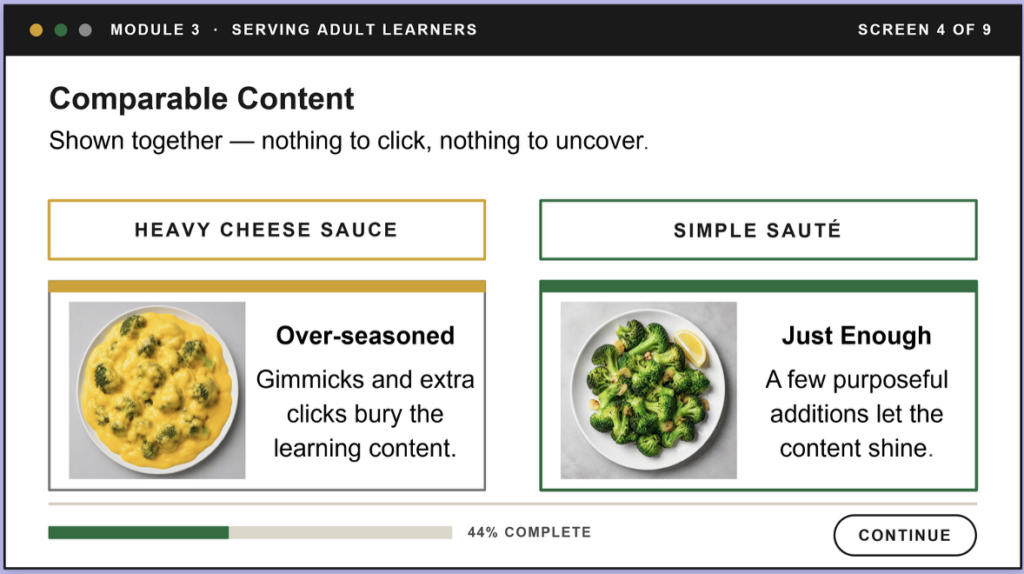
The better option is the other plate: a simple sauté that lets the vegetables—or, in this case, the learning goal—stand out, with only a few thoughtful additions to enhance value and appeal.
What Adult Learners Need
No two learners are the same, but most adult learners share a few common attributes. Adult learners expect to be treated as capable individuals whose prior knowledge, experience, and limited time are respected. Their consumption of learning is goal driven, and they are looking for immediate relevancy and practical application. This can all be achieved if we, as course designers, ditch the cheese sauce for the simple sauté. Designing with these expectations in mind means being intentional about what belongs in the course and what does not.
Start with a Clear Goal
Begin the design process with a precise understanding of the training goal. Anything that does not directly support that goal should be set aside. If you leave non-essential material in the course, it becomes the cheese sauce—hiding your learning goal and stealing your learner’s appetite.
Later, after the dish is composed, supporting and supplemental information can be added as an optional side. This is particularly useful when there is important prior knowledge that most, but not all, your learners will bring with them.
If you’re having trouble stating the goal in clear and concise terms, it could be that the goal simply isn’t clear and concise. You may be trying to put too much into one training. Ideally, a single training should have no more than three goals, less is better. A series of short trainings, instead of one large training, allows learners flexibility and control over their time and learning path.
Design the Experience Carefully
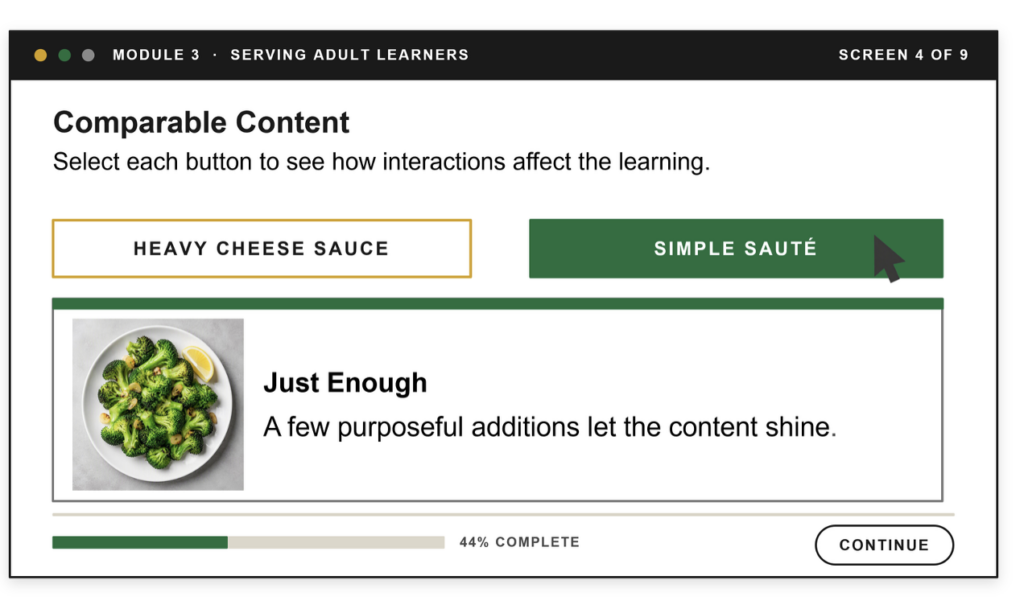
Once the content is defined, consider how learners will experience it. Interactions are like seasoning: necessary, but only when used with purpose and restraint. Adult learners are not clicking through your web-based training for entertainment and every interaction should add value. Simulations that mirror real-world situations are a strong example. Simpler interactions, such as buttons used to show comparable pieces of information together, can also add value. However, if using a different page layout would achieve the same result as adding buttons, the interaction becomes an example of over seasoning.
Presentation also matters. Variety in page layout can help maintain attention, but too much variation becomes distracting. Pages that serve similar purposes—such as introductions and summaries—should use consistent layouts so learners know what to expect before they take a bite.
White space is equally important. Used intentionally, it gives the mind room to process information and makes the content easier to navigate. Think of it as a palate cleanser for the brain.
Simple is Better
When designing for adult learners, forget the cheese sauce and aim for a more refined learning experience. The learning goal should be the only star on the plate. Add seasoning, but with purpose. Make the presentation appealing by keeping it intentional.

Elizabeth Schmidt has over 16 years of experience in training and curriculum development. She has developed for classroom, online, and hybrid settings. Her web-based development experiences includes 3D simulations, 2D immersive environments, and text-based instructional content. She holds a Master of Education degree from Union Institute and University, and dual Bachelor’s degrees in Public Relations and Political Science from Eastern Kentucky University.