
Protecting What Your Organization Knows: An Introduction to Knowledge Management
September 18, 2026 in Change, Transparency, & Communication, Industry Insights, Learning, Learning & Development, Teams
By Jen Long and Sarah Tucker
Every organization builds knowledge through its daily work. Employees develop expertise, teams document lessons learned, projects produce valuable insights, and relationships help work move forward. Yet too often, important knowledge can end up spread across email, shared folders, personal files, and informal conversations.
When knowledge is difficult to find or departs with employees when they change roles, organizations risk losing time, repeating mistakes, and missing opportunities to improve performance. Knowledge Management (KM) offers a structured way to address this common challenge.
What Is Knowledge Management?
Knowledge Management helps organizations identify, organize, share, use, and keep useful knowledge current. Employees can then easily find the information they need to make decisions, solve problems, and perform their work effectively. KM’s purpose is to make sure valuable know-how can be found, trusted, and applied again when needed.
Knowledge comes in many forms, like those included in the following graphic.
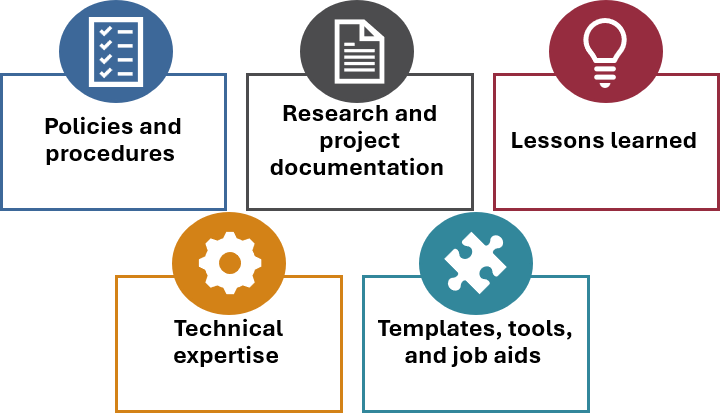
KM goes beyond saving files in one place. It is about making knowledge easy to find, practical to use, and reliable over time. Despite its importance, knowledge management is often misunderstood.
Misconception #1: KM is just a document repository
Tools and technology matter, but they are only part of what makes KM work. While SharePoint sites, and document libraries provide important storage capabilities, they do not automatically make knowledge useful. Without organization, governance, ownership, and maintenance, repositories quickly become cluttered and difficult to navigate.
Misconception #2: KM is an IT function
Technology supports KM, but KM depends on how people work together, how processes are designed, and what the organization encourages staff to share. Effective KM programs encourage employees to document expertise, share lessons learned, participate in communities, and contribute to continuous improvement.
Misconception #3: Knowledge sharing happens naturally
Many organizations expect knowledge sharing to happen on its own, but in reality, knowledge sharing often requires intentional processes such as pause and learn sessions, mentoring programs, knowledge transfer activities, communities of practice, and standardized documentation.
Misconception #4: KM only matters when someone leaves
Knowledge retention is an important KM objective, particularly during retirements, staff transitions, and organizational changes. However, KM improves everyday work by helping employees locate information faster, reduce duplication of effort, and apply proven practices to current work.
Why Organizations Invest in Knowledge Management
Organizations invest in KM because they recognize that what an organization knows is a major source of value. An effective knowledge management program helps organizations:
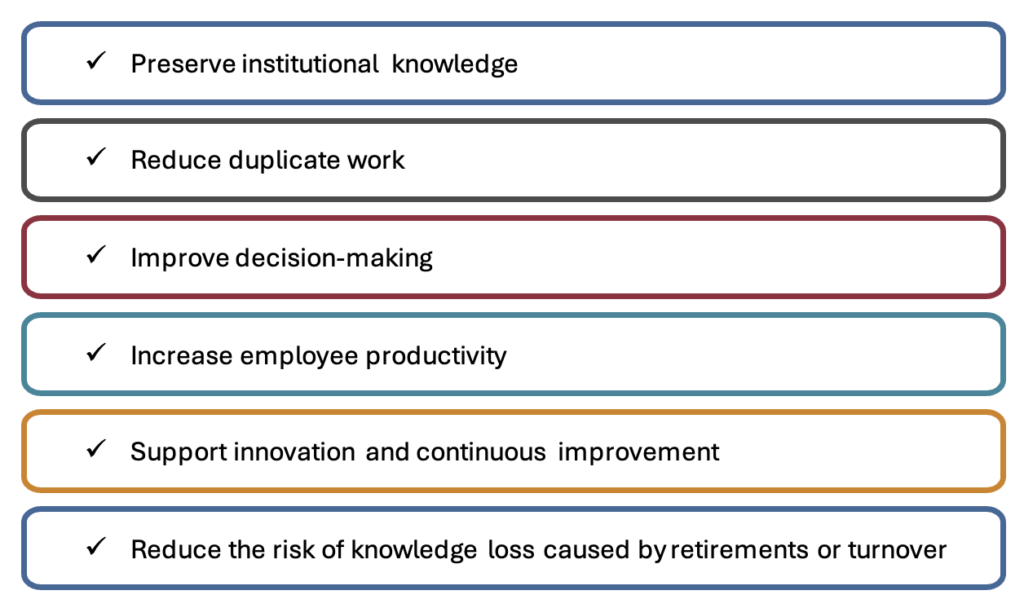
These benefits become especially important during periods of organizational growth, restructuring, or workforce transitions.
Consider a common scenario: a project team spends weeks developing a solution to a problem that another team solved two years ago. Without accessible knowledge, organizations repeatedly invest time and resources in finding answers that already exist. KM helps prevent this cycle by making the experience from two years ago easier to find and apply.
The Value of Making Knowledge Accessible, Usable, and Sustainable
Knowledge is useful only when employees can find it, understand it, and apply it.
Even the most comprehensive collection of documents has limited impact if employees cannot find what they need or determine whether the information is current and reliable. Effective KM programs do more than gather information, they emphasize organization, discoverability, governance, and ongoing maintenance.
This often includes activities such as:
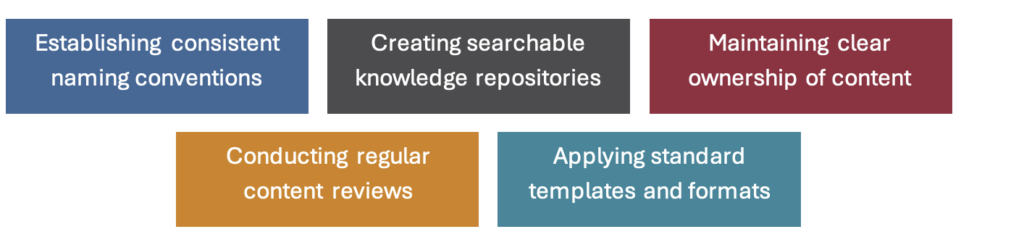
When knowledge is easy to locate and trust, employees spend less time searching and more time delivering valuable work.
How Knowledge Management Supports Organizational Effectiveness and Continuity
Strong KM practices support current operations while also protecting future continuity.
Knowledge management supports continuity by documenting and sharing expertise before it walks out the door. Common approaches include knowledge transfer interviews, mentoring, job shadowing, cross-training, lessons learned activities, and communities of practice.
Communities of Practice (CoPs), in particular, play an important role by bringing together individuals who share expertise, experiences, and best practices. These communities help turn personal experience into shared organizational learning, strengthen collaboration, and foster innovation across organizational boundaries.
Investing in KM helps organizations become more adaptable and resilient. They are better positioned to onboard new employees, adapt to change, and build on past successes rather than starting from scratch.
Looking Ahead
Understanding what KM is and why it matters is the first step. The next challenge is determining what effective KM looks like in practice.
In Part 2 of this series, we’ll explore practical strategies for building and sustaining successful knowledge management programs, examples of effective KM approaches, the role of Communities of Practice, and lessons learned from helping organizations create scalable, user-centered knowledge solutions.
Jen Long joined FMP as a Consultant in September of 2024. She earned a B.S. in Finance & Marketing from The University of Pittsburgh. Jen has experience in strategic communications, program management, and marketing. When she’s not working, you can find her cooking, cheering on her two kids at the hockey rink, or on a walk with her hound dog.
Sarah Tucker is a Senior Consultant at FMP LLC, helping organizations diagnose and solve work-related challenges. She earned an M.A. in Industrial/Organizational Psychology from Middle Tennessee State University. Sarah has worked with organizations to improve their effectiveness in multiple capacities for five + years. She is passionate about improving work-life and making a lasting impact on the human capital environment.