
Beyond FEVS: Transforming Employee Feedback into Workforce Intelligence
July 16, 2026 in Change Management, Industry Insights, Informed Decision-Making, Innovative Capabilities, Performance Management, Reflection & Feedback, Strategic Planning
By Nathan Bailey and Emma Wright
For more than two decades, the Federal Employee Viewpoint Survey (FEVS) served as the federal government’s primary tool for measuring employee engagement and workplace perceptions. Now, as the Office of Personnel Management (OPM) shifts responsibility for annual employee surveys to individual agencies, federal leaders face both a new challenge and a significant opportunity. Under OPM’s proposed approach, agencies will be responsible for and have flexibility in administering their own workforce surveys while continuing to meet statutory requirements for collecting employee feedback.
For many agencies, this represents a major transition, as historically, they could rely on OPM to manage survey administration and reporting. While having ownership over the process may be seen as an exciting prospect, it also poses the need to establish processes for survey deployment, participation tracking, data analysis, results communication, and action planning.
The good news? Agencies are no longer limited to a one-size-fits-all approach. They now have an opportunity to build workforce listening programs tailored to their unique mission and workforce needs.
Workforce Surveys Are More Than Compliance
Employee surveys are one of the most effective tools available for understanding organizational health, identifying workforce challenges, and evaluating the impact of organizational change. Agencies that approach workforce surveys as more than a compliance exercise can gain valuable insights that strengthen employee engagement, inform workforce planning, and improve organizational performance. The agencies best positioned to thrive in this new environment will be those that treat employee feedback as a strategic source of workforce intelligence rather than an annual reporting requirement.
What Agencies Need to Succeed
As agencies assume responsibility for survey administration, several practices will be essential:
Build Trust Through Communication
Employee participation depends on trust. Communication should begin well before survey launch and explain why the survey is being conducted, how confidentiality will be protected, and how feedback will be used.
Leadership endorsements, manager talking points, reminder campaigns, and post-survey updates all help reinforce the message that employee input matters and will drive action. When supported by a thoughtful communications strategy, agencies can significantly increase participation and the quality of feedback collected.
Focus on Actionable Insights
Survey results should do more than measure employee sentiment. Effective analysis helps leaders understand trends, differences across workforce groups, and the underlying drivers of employee engagement.
Rather than producing reports that sit on a shelf, agencies should use survey data to guide workforce investments, management actions, and organizational improvements.
Turn Feedback into Action
Employees quickly become skeptical when surveys fail to lead to visible improvements. As such, agencies should establish focused action plans, assign ownership, measure progress, and regularly communicate updates to employees.
Just as importantly, action planning should involve leaders, managers, and employees alike. Broad participation strengthens buy-in and increases the likelihood of sustained change.
A Proven Path Forward
While many agencies will be building these capabilities for the first time, they do not need to start from scratch.
FMP has direct experience managing the full lifecycle of workforce survey operations for a federal financial regulatory organization with nearly 5,000 employees. Our support spanned the full lifecycle, including survey design, deployment, communications, participation tracking, help desk support, analytics, executive reporting, dashboard development, and action planning activities. Through a comprehensive communications strategy, FMP helped drive participation rates above 80%, which falls well above typical federal survey response rates.
In addition to this end-to-end implementation experience, FMP has supported workforce engagement, FEVS analysis, and action planning efforts across numerous federal agencies, including organizations such as USCIS, NARA, and the Department of State.
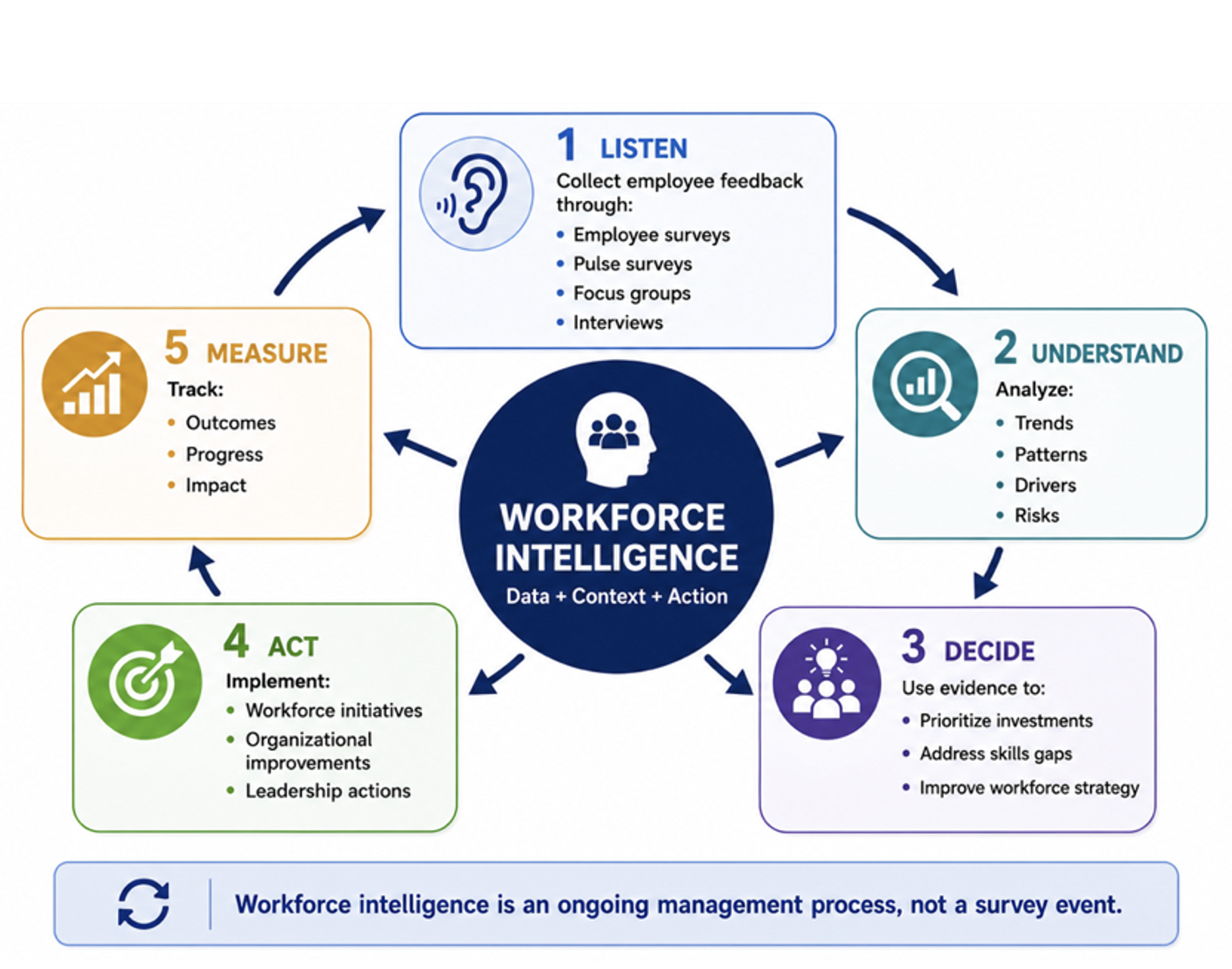
FMP’s approach is built on proven federal implementations that can be rapidly adapted to agency-specific requirements. Rather than creating an entirely new program, agencies can leverage established processes, tools, dashboards, and reporting capabilities that have already been successfully implemented in federal environments. Leveraging automation, advanced analytics, and interactive dashboards, we accelerate the path from data collection to decision-making, enabling leaders to spend less time interpreting results and more time taking targeted action. Rather than delivering static reports, FMP equips agencies with timely insights, meaningful visualizations, and practical recommendations that support continuous workforce improvement. These capabilities are supported by secure, FedRAMP-authorized technologies that align with federal security and compliance requirements.
Beyond survey administration, FMP also helps agencies transform employee feedback into workforce intelligence. By combining federal human capital expertise, industrial-organizational psychology, advanced analytics, and data visualization, FMP helps leaders identify trends, uncover risks, and make evidence-based decisions that improve organizational effectiveness.
Looking Ahead
The decentralization of FEVS administration represents one of the most significant changes to federal employee feedback practices in years. While OPM has signaled a shift toward agency-owned survey programs, many agencies are still seeking additional guidance on implementation responsibilities, governance, and operating models. This uncertainty creates both challenges and opportunities. Agencies that proactively establish strong survey, analytics, and action-planning processes will be better positioned to identify workforce challenges, measure the impact of improvement efforts, and make informed decisions.
Ultimately, the value of employee surveys lies not in collecting feedback, but in using it to drive meaningful organizational action. Agencies that embrace this opportunity can move beyond annual survey administration and establish sustainable workforce listening capabilities that provide ongoing insight into organizational health and the workforce intelligence needed to achieve their mission.

Nathan Bailey is a Managing Director and has been with FMP since 2007. He has a PhD in Industrial/Organizational Psychology and leads up FMP’s Analytics Technology and Transformation Center of Excellence. Although originally from Ohio, Nathan has lived in Virginia for nearly 30 years and loves heading to National’s Park, taking in the scenery in Shenandoah, and spending time with family.

Emma Wright joined FMP in 2020. She is a Senior Consultant in the Learning and Development Center of Excellence and is the FMP Blog Editor. She supports a variety of initiatives across multiple clients, including program management, strategic planning and communications, and training and development. She hails from Alexandria, Virginia, and you can often find her cooking, out at a concert, or eating at her favorite DC restaurants.