
Moving Beyond AI Experimentation: A Practical Framework for Sustainable Adoption
September 1, 2026 in AI, Industry Insights, Innovative Capabilities, Strategic Planning, Technology & Tools
By Jacob Flinck
Across organizations, the AI conversation is evolving. Recent research[i] finds that nearly nine in ten organizations are using AI in at least one business function, yet most remain in the early stages of scaling it successfully across the enterprise.
The question is no longer whether AI has potential. Most leaders have already seen what AI can do. Teams are testing new tools, experimenting with use cases, and exploring ways to improve productivity and service delivery. The challenge is now focused on how organizations move from isolated experimentation to integrated, sustained adoption.
Many organizations have launched pilots, provided access to AI tools, or encouraged employees to explore new capabilities. Yet progress often feels uneven[ii]. Interest is high, but adoption varies. Promising use cases emerge, but implementation slows. Employees are eager to experiment, while leaders are still working through governance, training, and long-term strategy. What many organizations discover is that AI implementation is not simply a technology challenge. It is an organizational capability challenge.
The organizations making the most sustainable progress are not necessarily the ones deploying the most tools. They are the ones building the conditions that allow AI to be adopted responsibly, consistently, and at scale. That requires a deliberate approach for moving from ideas to implementation.
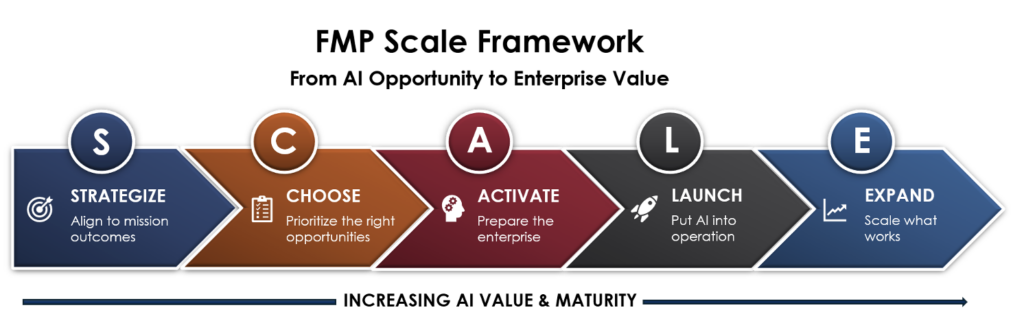
To help organizations move from AI experimentation to sustainable adoption, we developed the SCALE Framework.
Creating a Path from Opportunity to Capability
SCALE provides a practical approach for helping organizations move from AI curiosity and experimentation to sustainable adoption. Rather than treating AI as a standalone technology initiative, the framework connects organizational priorities, implementation decisions, workforce readiness, governance, and continuous improvement.
The framework is built around five actions: Strategize. Choose. Activate. Launch. Expand. Together, these actions provide a structured way to move from opportunity to organizational capability.
Start with Strategy, Not Technology
Organizations often begin with technology. The first question becomes which tool to purchase, which platform to deploy, or which capability to test. SCALE intentionally starts somewhere else.
The Strategize phase focuses on outcomes. Before discussing technology, leaders establish where AI can support organizational priorities, improve operations, strengthen workforce effectiveness, or create value. Success metrics are identified early (e.g., operational efficiency, business ROI, user adoption), helping to ensure future investments remain connected to meaningful objectives.
This may seem straightforward, but many implementation efforts struggle because technology decisions are made before organizational priorities are clearly defined. A common understanding of desired outcomes creates a stronger foundation for everything that follows.
Choose the Opportunities That Matter Most
Most organizations are not facing a shortage of AI ideas; they are facing an abundance of them. Once strategy is established, the next challenge is deciding where to focus first.
The Choose phase helps organizations identify, assess, and prioritize opportunities based on value, feasibility, readiness, risk, and expected impact. Rather than pursuing every promising idea, leaders can develop a portfolio of opportunities that balance quick wins with longer-term investments. This helps organizations move beyond experimentation for experimentation’s sake and focus resources where they can create the greatest value.
Build the Conditions for Success
This is often where implementation efforts encounter their first real barriers. Organizations may identify promising opportunities and establish a clear direction, but adoption rarely succeeds through strategy alone. The challenge becomes turning ambition into an organizational capability.
The Activate phase focuses on creating the conditions that support responsible adoption. Governance establishes clear expectations and accountability. Workforce readiness helps employees understand how AI fits into their work. Data and technology provide the foundation AI relies upon. Training, communication, and change management help build confidence and consistency as new ways of working emerge.
Many organizations discover that scaling AI is less about finding additional use cases and more about strengthening these underlying capabilities. When those foundations are in place, implementation becomes significantly easier. When they are not, even promising initiatives can struggle to gain traction.
Consider two agencies implementing the same AI tool: one focuses primarily on technical deployment, while the other invests in governance, workforce readiness, communications, leadership engagement, and adoption support before launch. Both may activate the technology on the same day, but only one has activated the organization. The difference often determines whether AI remains a pilot or becomes a sustainable capability.
Turn Ideas into Operational Reality
Successful implementation requires more than deployment; it requires learning.
The Launch phase focuses on piloting, testing, refining, and preparing the workforce to use AI effectively in real operating environments. Organizations validate assumptions, gather feedback, identify potential risks, and make adjustments before broader adoption.
Many AI initiatives begin at this stage. Organizations deploy a tool and then work backward to address governance, training, leadership expectations, and user adoption. SCALE intentionally takes a different approach. By the time an organization reaches the Launch stage, the strategic direction has been established, priority opportunities have been identified, and the foundational capabilities needed to support adoption are already in place.
This sequencing matters. AI may be ready for deployment, but organizations must also be ready to use it. Launch is not simply the introduction of a new tool. It is the point at which strategy, governance, workforce readiness, and technology come together to support real-world adoption. The objective is not simply to prove that a tool works. It is to understand how people, processes, governance, and technology work together to create value.
Expand What Works
One of the most common misconceptions about AI implementation is that deployment represents the finish line. In practice, it is often the beginning.
The Expand phase focuses on measuring outcomes, monitoring adoption, capturing lessons learned, improving capabilities, and scaling successful approaches across the organization. Organizations continuously refine what is working while reassessing priorities as technologies and organizational needs evolve. This creates a cycle of learning that transforms isolated successes into repeatable organizational capabilities.
As organizations continue exploring AI, many are asking similar questions:
- Where should we focus our efforts?
- How do we prioritize competing opportunities?
- What governance and workforce capabilities are needed?
- How do we move beyond pilots?
- What does responsible scaling actually look like?
These questions are not signs that organizations are falling behind. They are signs that the conversation is maturing. AI adoption is often discussed through the lens of technology. Yet the most durable progress tends to come from organizations that recognize AI as a broader organizational capability. They align priorities, prepare their workforce, strengthen governance, learn through implementation, and continuously refine their approach over time.
The goal is not simply to adopt AI.
The goal is to build the capability to adopt AI responsibly, repeatedly, and sustainably as technologies continue to evolve. That is the challenge SCALE was designed to address. And for organizations looking to move beyond experimentation, having a clear path forward is just as important as the technology itself.
If you’re in the process of introducing AI to your workforce, check out these related blogs for further insights:
- When AI Ambition Meets Federal Reality (Part 1)
- When AI Ambition Meets Federal Reality (Part 2)
- When AI Ambition Meets Federal Reality (Part 3)
- AI Adoption is Really About People, Not Tech

Jacob Flinck is a Managing Consultant at FMP and co-lead of the firm’s Strategic Communications Community of Practice (CoP), where he helps organizations make sense of complex change and communicate with clarity during moments of transition. His work sits at the intersection of organizational change, strategic communications, and emerging technology, with a particular focus on helping leaders responsibly integrate AI into everyday work. Jacob partners with teams to ensure technology transitions, especially AI-enabled ones, are grounded in people, purpose, and sustained adoption, not just tools. Outside of work, he finds inspiration in travel and creativity in the kitchen through cooking and baking.
[i] https://www.mckinsey.com/capabilities/quantumblack/our-insights/the-state-of-ai; https://digitaleconomy.stanford.edu/project/indicators/adoptionmonitor/
[ii] Assessing the state of AI adoption across the federal government | Brookings; https://www.ey.com/en_us/newsroom/2026/04/federal-government-agencies-efficiency-efforts-face-significant-barriers